
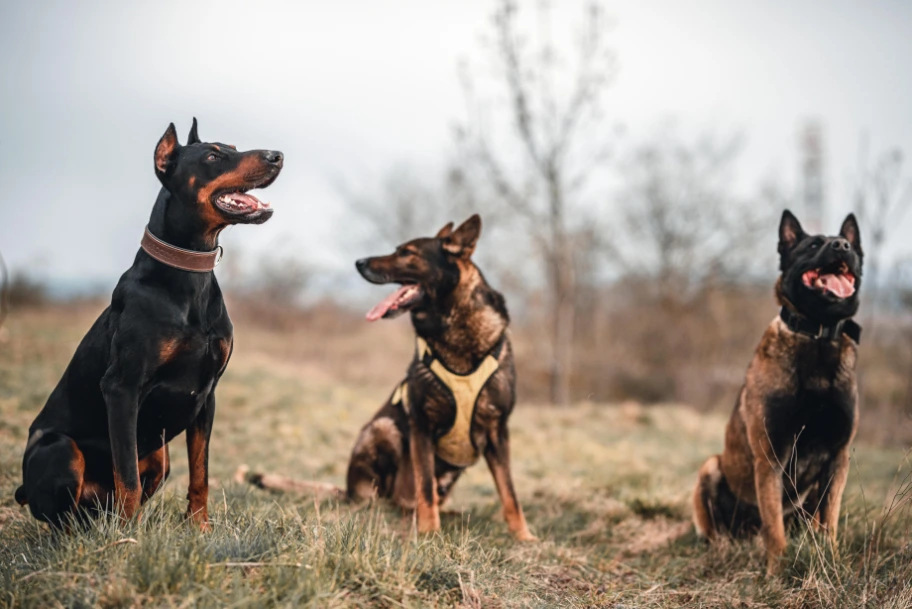
| Positive reinforcement adds something your dog wants (food, play, praise) right after a behavior so that behavior happens more often. Balanced dog training uses rewards plus corrections, often with tools like prong collars or remote training collars, so it works across all four quadrants of operant conditioning. The research leans one way: the AVSAB position statement says reward-based methods are at least as effective as aversive ones, with fewer welfare risks. For most everyday manners, rewards are where we start and usually where we finish. Corrections are not a shortcut. If a trainer suggests one, they should explain why, start at the lowest level, and show you the reward plan around it. |
Balanced dog training vs positive reinforcement is one of the most heated debates in the dog world, and if you’ve searched for a trainer in Salt Lake County lately, you’ve probably seen both labels on the same page of results. The short answer: positive reinforcement teaches with rewards, while balanced training mixes rewards with corrections.
The longer answer matters more, because the label on a trainer’s website tells you far less than what actually happens in a session. Here’s how each approach works, what the science says, and the questions that will tell you whether a program fits your dog.
What is the difference between balanced training and positive reinforcement?
The main difference is whether the plan includes aversives. An aversive is anything the dog finds unpleasant enough to avoid, like a leash pop, a prong collar tightening, or stimulation from a remote collar.
Think of it like teaching a teenager to drive. One instructor only says “nice job” when they check their mirrors. Another does the same, but also taps the brake when they drift. Both are teaching, but the second one adds an unpleasant consequence to the mix.
| Positive reinforcement (reward-based) | Balanced training | |
|---|---|---|
| Core idea | Reward the behavior you want | Reward good choices, correct unwanted ones |
| Quadrants used | Mostly positive reinforcement and negative punishment | All four quadrants |
| Common tools | Treats, toys, clicker, flat collar, harness, long line | Same, plus prong, slip, or remote training collars |
| What the dog learns | “This behavior pays” | “This behavior pays, that one costs” |
| Main risk | Slower progress if rewards are low value or timing is off | Fear, stress, or aggression if corrections are mistimed or too strong |
| Best fit | Puppies, anxious dogs, most manners and obedience | Specific cases a qualified trainer can justify, after rewards are in place |
How does operant conditioning shape both methods?
Operant conditioning is the learning process where a dog connects a behavior with its consequence. Psychologist B.F. Skinner described four “quadrants,” and every training style uses some combination of them.
The words “positive” and “negative” here work like math, not morality. Positive means you add something. Negative means you take something away.
- Positive reinforcement (R+): add something good. Your dog sits, you hand over a treat.
- Negative punishment (P-): remove something good. Your dog jumps for attention, you turn away.
- Negative reinforcement (R-): remove something unpleasant. Leash pressure releases the moment your dog stops pulling.
- Positive punishment (P+): add something unpleasant. A leash pop when your dog lunges.
Reward-based trainers lean on the first two. Balanced trainers use all four, which is where the name comes from. PetMD’s breakdown of the four quadrants walks through the same framework with more examples if you want to go deeper.
What is positive reinforcement dog training?
Positive reinforcement dog training is a reward-based method that strengthens a behavior by following it with something the dog values. Food is the usual currency, but play, praise, sniff breaks, and access to the door all count.
Picture a slot machine. Your dog keeps “pulling the lever” (sitting, checking in, walking beside you) because sometimes it pays out. Over time, the behavior becomes a habit, and you can fade the treats to occasional jackpots.
Many reward-based trainers follow the LIMA principle (Least Intrusive, Minimally Aversive). It means picking the gentlest method likely to work, and only stepping up if it doesn’t.
Where it shines:
- Puppy foundations: name, sit, down, recall, and crate comfort, covered in our puppy training program.
- Fear and anxiety: rewards help change how a dog feels about a trigger, not just how it acts.
- Everyday manners: loose-leash walking, polite greetings, and settling on a mat.
What is balanced dog training?
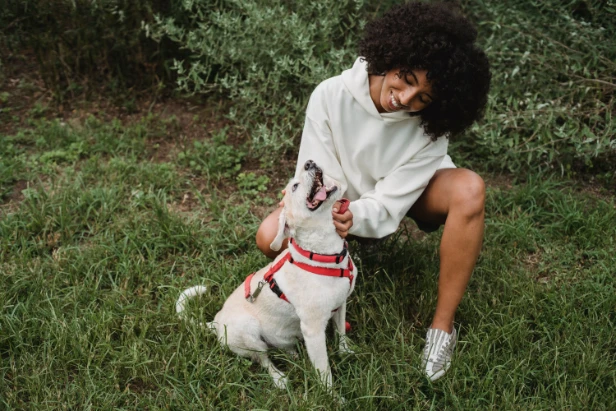
Balanced dog training is a method that combines rewards for wanted behavior with corrections for unwanted behavior. A balanced trainer might pay a dog for heeling, then add a quick leash correction when the dog lunges toward a squirrel.
The tools vary. Some balanced trainers use slip leads and prong collars. Others use remote training collars (often called e-collars), which deliver a stimulation the handler controls from a remote.
Here’s the thing: “balanced” covers a huge range. One trainer’s version means a remote collar set at a level the dog barely notices, layered over hundreds of rewards. Another’s means harsh corrections for every mistake. The label alone tells you almost nothing about what your dog will feel.
What does the research say about balanced dog training vs positive reinforcement?
The research favors reward-based training. In its position statement on humane dog training, the American Veterinary Society of Animal Behavior (AVSAB) recommends reward-based methods for all training and behavior modification, and reports that dogs trained with aversive methods showed more stress-related behaviors.
Two peer-reviewed studies come up again and again:
- A 2020 PLOS ONE study of companion dogs by Vieira de Castro and colleagues found more stress behaviors during training, and a more “pessimistic” outlook in a later cognitive test, among dogs from aversive-based schools.
- A 2020 Frontiers in Veterinary Science study by China, Mills, and Cooper compared remote-collar training with reward-based training for recall and chasing problems. The reward-based group performed at least as well.
We’ll be straight with you: the evidence does not show that adding corrections makes dogs learn faster or better. That’s why rewards are the foundation of every program we run, and why any tool that adds pressure has to earn its place in a plan.
When might a trainer add a correction tool?
Some trainers add a correction tool when a dog needs reliability around distractions that food can’t compete with, like off-leash recall on a hiking trail full of deer. That’s the most common case we hear about from Salt Lake County owners.
If a trainer recommends one, the details matter more than the tool. Our approach to e-collar training follows three non-negotiables:
- Condition first. The dog learns what the collar means before it’s ever used to train a behavior.
- Start at the lowest level the dog notices. The goal is a tap on the shoulder, not discomfort.
- Keep rewards in the plan. Food, play, and praise still do the heavy lifting.
For a deeper look at how remote collars work and when they don’t belong in a plan, read our guide to e-collar training for dogs.
And a firm caveat: corrections are a poor choice for fearful, anxious, or aggressive dogs. Adding discomfort to a dog that’s already scared can suppress the warning signs without fixing the fear underneath, which is how “he bit out of nowhere” stories happen.

Which method is better for reactive or aggressive dogs?
For reactive and aggressive dogs, reward-based behavior modification is the safer starting point. Reactivity is usually driven by fear, frustration, or overexcitement, and the fix is changing how the dog feels about the trigger.
Picture a dog that lunges at other dogs on walks. A correction might stop the lunge today. But if the dog learns “other dogs show up, then my neck hurts,” the fear grows, and the next outburst can be worse.
Counterconditioning (pairing the trigger with something great, at a distance the dog can handle) takes longer to explain but tends to hold up. Our reactivity training and aggressive dog training programs are built around that idea. If you’re still figuring out which problem you have, start with dog reactivity vs aggression.
How do you choose the right dog training method for your dog?
Choose the dog training method by matching it to your dog’s temperament, your goal, and the trainer’s transparency, not by the label. A good trainer will happily answer every question below.
| Question to ask | Good answer sounds like |
|---|---|
| What will you do when my dog gets it right? | A clear reward plan with specific reinforcers |
| What happens when my dog gets it wrong? | Management and redirection first, with any correction explained in detail |
| Which tools will you use, and why? | Tools matched to a specific goal, never “every dog wears one” |
| How will you know if my dog is stressed? | Named body language signs, plus a plan to back off |
| What will I practice between sessions? | Written homework you can actually do |
A few quick rules of thumb:
- Prioritize positive reinforcement if you have a puppy, a fearful or reactive dog, or goals centered on manners at home.
- Ask harder questions if a trainer recommends a prong or remote collar in the first session, before seeing your dog work with rewards.
- Walk away if a trainer can’t explain their methods in plain language, or won’t let you watch.
What does training look like with K9 Harmony?
Every program starts in your home, because that’s where most behavior problems actually happen. Owner and trainer Brittany meets your dog, watches how they respond, and builds the plan around your dog rather than a method label.
Our in-home dog training runs as a 6-lesson program across Salt Lake County, with homework after every lesson. Most foundation work happens through our dog obedience training, using rewards, structure, and clear communication.
Not sure where to begin? Book a $75 in-home assessment and we’ll talk through which approach makes sense for your dog.
Frequently asked questions
Is balanced dog training cruel?
Not automatically, but it carries more risk. The outcome depends on the tools, the timing, and the intensity. A correction that’s too strong, poorly timed, or used on a fearful dog can create stress and fallout. That’s why veterinary behavior groups like AVSAB recommend reward-based methods as the default, and why any trainer using corrections should explain exactly how and why.
Is positive reinforcement training enough for stubborn dogs?
Usually, yes. “Stubborn” dogs are often under-motivated, distracted, or confused about what’s being asked. Raising the value of the reward, lowering distractions, and breaking the behavior into smaller steps solves most of it. Breeds bred to work independently, like many hounds, simply need better pay and more patience, not harsher consequences.
Does positive reinforcement mean you never say no?
No. Reward-based training still sets limits. It uses management (leashes, gates, crates), redirection, and removing rewards, like ending play when teeth touch skin. What it avoids is adding pain or fear. Your dog still learns that some choices don’t work. They just learn it without a correction.
Can you switch from balanced training to positive reinforcement?
Yes. Many dogs adjust quickly once rewards become predictable. Expect a short period where your dog is unsure, especially if corrections used to follow certain cues. Rebuild those cues with high-value rewards in low-distraction spaces first, then add real-world practice gradually.
What age should a puppy start positive reinforcement training?
As soon as they come home, usually around 8 weeks. Puppies learn constantly, so short reward-based sessions for name response, sit, and crate comfort set a strong foundation. Our guide on how to socialize a puppy covers the early weeks in more detail.
How long does positive reinforcement dog training take to work?
Simple cues like sit often click within a few days of short daily sessions. Reliable behavior around distractions takes weeks of practice, and behavior problems like reactivity can take months. Consistency at home matters more than the length of any single session.
The bottom line
Positive reinforcement and balanced training both use rewards. The difference is whether corrections join the plan, and the research says rewards should carry the load. Pick a trainer who can explain every step, watch your dog’s body language as closely as you do, and build skills you can keep practicing long after the last lesson.