
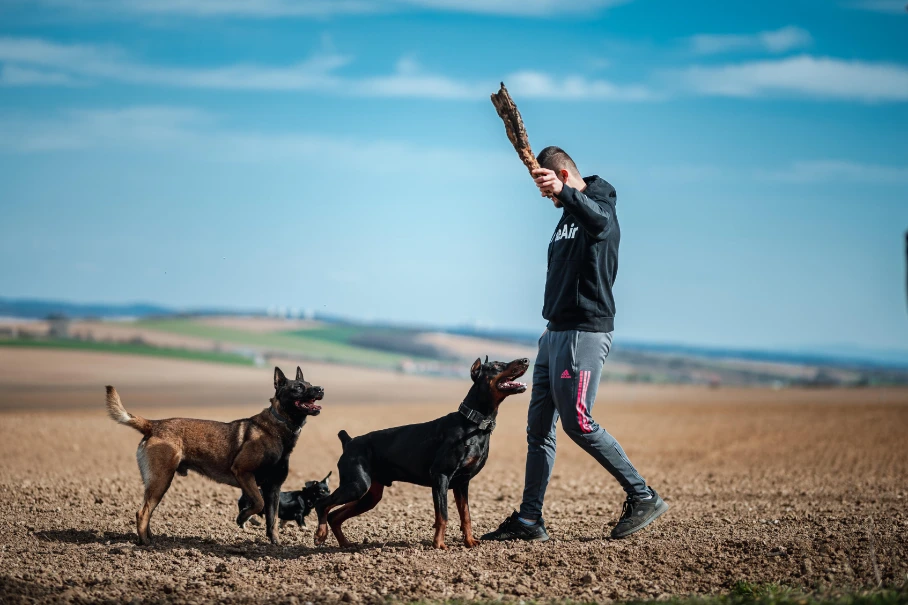
Off leash dog training is the skill most owners want and few dogs have truly earned. We get the appeal. Watching a dog run, sniff, and turn on a dime when called is a joy.
Here’s our honest position: the leash comes off only when your dog’s recall holds up under real distraction, not when they behave well at home. A dog who bolts toward a road doesn’t get a second chance. So before you unclip anything, work through the checklist below.
- Off-leash reliability means your dog responds to your voice around real distractions, not just in your living room.
- Your dog is ready when recall, check-ins, and impulse control hold up outdoors on a long line.
- Dogs with strong prey drive, especially scent hounds and terriers, may never be fully reliable in open areas.
- Build the skill in stages: leash, long line, fenced space, then low-risk outings.
- In Millcreek Canyon, Salt Lake County says dogs may be off leash on trails only on odd-numbered days.
What does off-leash dog training actually involve?
Off-leash dog training teaches a dog to stay close, pay attention, and respond to cues when nothing physically connects them to you. Voice control (reliable response to your spoken cue) replaces the leash.
Think of recall (coming when called) as a bank account. Every time your dog comes and gets something great, you make a deposit. Calling them only to end the fun is a withdrawal, and a dog with an empty account stops showing up.
The foundation is ordinary obedience, the kind our basic life skills training builds. Pat Miller (CBCC-KA, CPDT-KA) lays out the sequence in Whole Dog Journal’s off-leash guide: solid cues on leash, then a long line, then gradual distractions in unfenced areas.
A cue learned in your kitchen won’t automatically work at the park. Trainers call this generalization: teaching the same skill in many different places.
How can you tell if your dog is ready for off-leash freedom?
Your dog is ready when all seven of these hold up outdoors, with distractions, on a long line.
- Recall works the first time. Your dog turns and comes at the first call, even with a squirrel, a jogger, or a dropped sandwich nearby.
- Check-ins happen on their own. Your dog glances back or circles in without being asked.
- Impulse control is solid. They can wait at a door, ignore a dropped treat on “leave it,” and hold a stay while something exciting happens.
- Core cues are instant. Sit, down, stay, and leave it work in new places, not just at home.
- Other dogs and people don’t derail them. A ready dog passes others calmly or can be called away.
- Prey drive is manageable. Chasing instincts don’t override your cue (more on this below).
- Long-line success is proven. You’ve repeated all of the above, many times, in different places.
Sniffspot’s off-leash guide, reviewed by two CPDT-KA trainers, lists come, stay, leave it, and check-in as the core behaviors to train first.
If your dog lunges, growls, or panics around other dogs or people, don’t skip ahead. Start with our aggression and reactivity program, because a reactive dog off leash puts everyone at risk.
Which dogs may never be fully reliable off leash?
Dogs with strong prey drive, a habit of wandering, or serious fear may stay safest on a long line or in fenced spaces for life. Prey drive (the instinct to chase moving things) is the biggest factor.
Picture your phone buzzing during a movie you love. You can ignore it, but it takes effort. For many scent hounds and terriers, every squirrel buzzes like that.
Breed is a hint, not a verdict, so every dog needs proof instead of assumptions.
None of this is failure. A dog on a 30 foot line in a big field has a very good life, and we’d take that over a lost or injured dog.
Fear is the other big one, since a dog who bolts when startled can’t be trusted without a line. Our anxiety and hyperactivity program helps dogs who struggle to settle and stay mentally present, which is what reliable recall depends on.
What is the safest step-by-step way to build off-leash reliability?
If you’re wondering how to train a dog to be off leash, the honest answer is slowly, in stages. Move on only when the current stage feels boringly reliable.
- Lock in the basics on leash. Practice recall, leave it, stay, and check-ins in your yard and on quiet streets until they’re automatic.
- Move to a long line. Dogster’s vet-verified guide suggests a 15 to 30 foot leash. A long line works like training wheels on a bike: your dog feels free, but you can still catch the wobble.
- Teach an emergency recall. Choose a separate cue, pair it with your very best reward, and use it only for real emergencies and practice.
- Add distractions slowly. Start with a toy on the ground, then people at a distance, then other dogs far away.
- Practice in a fenced space. A securely fenced area lets your dog run at full speed while you test recall.
- Graduate to low-risk outings. Choose quiet places where off-leash is allowed, and keep the line dragging at first. If reliability slips, go back a stage.
Can an e-collar help with off-leash reliability?
An e-collar (a remote training collar that delivers adjustable electronic stimulation) can help some dogs, but only as a communication tool on top of solid foundation work.
Trainers genuinely disagree here, and some force-free professionals avoid e-collars entirely. We’d say the tool never replaces recall training, and it’s the wrong choice for a fearful dog without professional guidance.
If you’re curious whether it fits your dog, our e-collar training service is the place to start.
What are the off-leash rules in Salt Lake County?
Leash laws vary by location, so check the posting before you unclip. We’re dog trainers, not attorneys, so treat this as a starting point.

In Millcreek Canyon, Salt Lake County’s canyon page says dogs must be on leash at all times on even-numbered days. On odd-numbered days, dogs may be off leash on trails, and watershed areas are closed to dogs. That page was published in 2022 and shows no update date, so confirm current signage on arrival.
In February 2024, KMYU reported that police were ramping up leash law enforcement after a surge of unleashed dog complaints, and it pointed readers to Salt Lake County Animal Services for exact requirements.
Which mistakes put off-leash dogs at risk?
Most off-leash accidents trace back to a few repeat mistakes:
- Going off leash too soon. One or two great outings aren’t proof.
- Testing recall near a road. Always test near safe boundaries first.
- Assuming friendly means safe. A friendly dog rushing a leashed, fearful dog can start a fight.
- Letting practice lapse. Recall fades without rewarded repetition.
- Skipping identification. Use a collar with ID tags and a registered microchip. A GPS tracker adds a safety net.
Frequently asked questions about off-leash dog training
Can every dog be trained to be off leash?
No, and that’s okay. Dogs with high prey drive, strong wandering habits, fear, or reactivity may be safest on a long line or in fenced areas. Most dogs can improve their recall, but “improved” and “safe near traffic” are different standards.
How long does off-leash training take?
There’s no fixed timeline. Plan on months of consistent practice, not weeks. Dogs with strong foundations and owners who practice daily move faster than dogs learning recall and impulse control from scratch.
Is it safe to walk my dog off leash?
It’s safe only in the right places with the right dog. Even well-trained dogs can bolt after wildlife or run into traffic. Use fenced spaces or a long line until recall holds up with real distractions.
What should I do if my dog runs away?
Stay calm, and don’t chase, because chasing turns it into a game. Use your emergency recall cue, then move away or crouch so your dog comes to you. Reward them generously on arrival, even if they were slow.
Does a fenced yard count as off-leash training?
It’s a good start, but it isn’t proof. A fenced yard has few distractions, so reliability there rarely transfers to a park. Use it to build foundations, then move to a long line in real environments.
At what age can a puppy go off leash?
Young puppies tend to stay close by instinct, which can hide a weak recall. Adolescence often brings selective hearing, so keep a long line on until recall is proven.
Not sure your dog is ready? Get a second set of eyes
Our trainer, Brittany, has worked with dogs for more than ten years, and you can read her story here. We train in your home across the Salt Lake City area, so we see how your dog behaves where they actually live.
If you want a plan matched to your dog’s drive and personality, book a Free Call Consultation. You can also browse answers to common questions on our FAQ page.